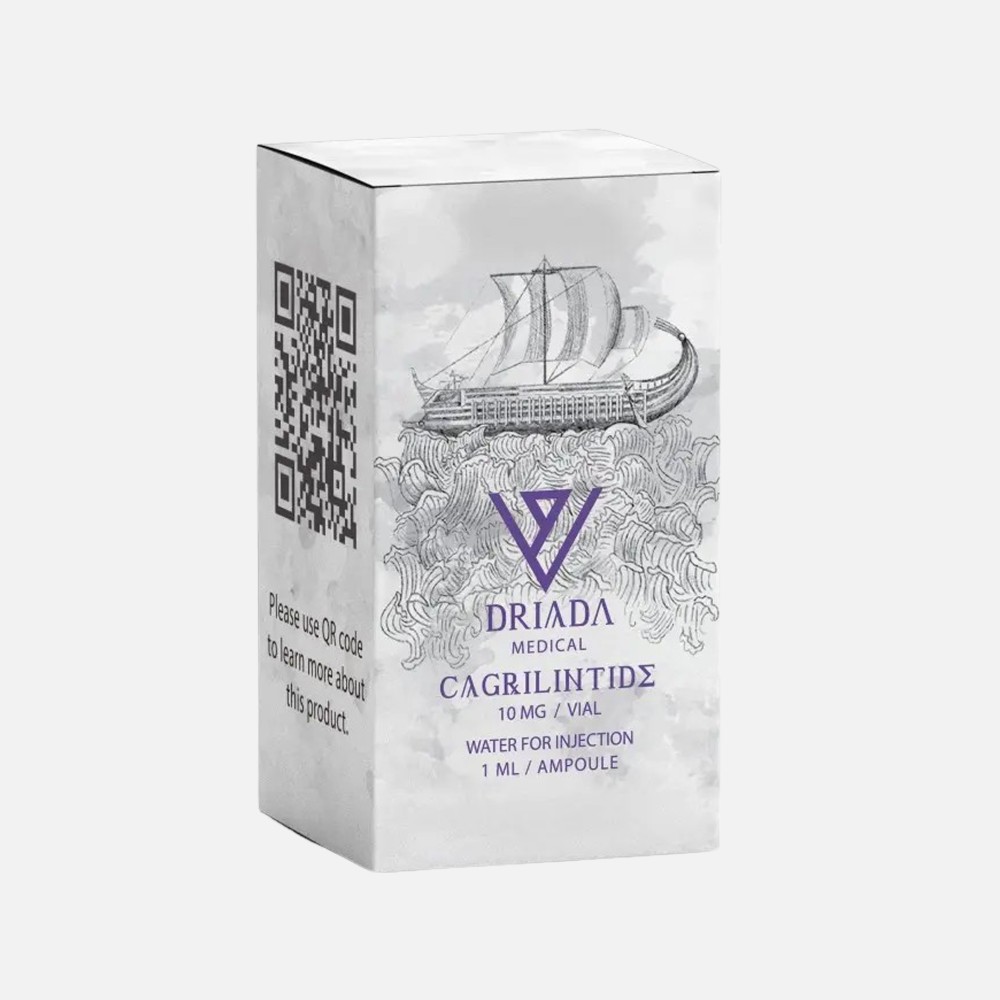
Description
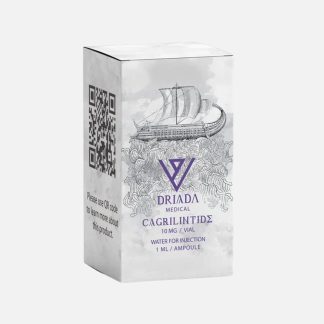
- Composition: Cagrilintide 10 mg.
- Category: Peptide.
- Use: Weight loss, appetite suppression.
- Form: Vial with 10 mg of lyophilized powder + 1 ml ampoule of water for injections.
- Application: Subcutaneous injections.
What is Cagrilintide?
Cagrilintide is a peptide developed to reduce body fat, control appetite, and lower the risk of diabetes. The medication activates amylin receptors, which regulate the feeling of satiety and the speed of gastric emptying.
It has a different mechanism of action than GLP-1 receptor agonists (such as semaglutide, tirzepatide, or retatrutide), so it can be acquired and combined with them to achieve more effective weight loss – especially if other medications have lost their efficacy. It is also effective alone in small doses, particularly when maintaining maximum muscle mass is important.
Main effects of Cagrilintide
- Reduces appetite and decreases cravings for high-calorie foods.
- Increases the feeling of satiety after eating.
- Slows down gastric emptying, making the feeling of satiety last longer.
- Makes it easier to maintain a calorie deficit without constant hunger.
- Promotes fat loss, primarily from fat tissue rather than muscle mass.
- Helps preserve muscle mass when combined with regular training and adequate protein intake.
- Improves dietary discipline during strict diet phases or competition preparation.
How is Cagrilintide taken?
Cagrilintide comes in a vial with 10 mg of lyophilized powder. Before use, it should be reconstituted with water for injections.
Instead of the usual dilution with 1 ml, we recommend using 2 ml. This makes accurate dosing of small amounts easier and reduces the risk of overdose, as the product is concentrated and should be started at a very low dose.
For convenience, you can buy a 10 ml vial of water for injections in our shop: .
You can find detailed instructions on how to prepare peptides and perform injections .
Weekly Cagrilintide Schedule
(Dilution: 10 mg Cagrilintide + 2 ml water for injection purposes)
Weeks Weekly dose Hints 1–4 0.3 mg Initial dose – check tolerance before increasing 5–8 0.6 mg Only increase if no side effects occur 9–12 1.2 mg Gradual increase – observe reaction 13–16 1.8 mg For stronger effect with good tolerance 17+ 2.4 mg Maximum dose – do not exceed
- Inject once a week, always on the same day.
- Can be taken with or without food, but a consistent routine is recommended.
- If you miss a dose:
- Take it as soon as possible if more than 3 days remain until the next dose.
- If less than 3 days remain until the next scheduled dose, skip the missed one.
If you want to reduce side effects, especially when combining with other medications like semaglutide, start with the lowest dose and only increase it after adjusting the other medication, not simultaneously. For example, if you increase semaglutide after 4 weeks, wait another 1–2 weeks before increasing the Cagrilintide dose.
Precautionary measures
- Do not use if you have a known allergy or intolerance to the ingredients.
- Use caution when combining with GLP-1 receptor agonists if you have never taken such medications before – it is safer to use only one initially.
- Avoid in cases of severe gastrointestinal diseases that delay gastric emptying.
- In diabetes, an adjustment of insulin or other blood sugar-lowering medications may be necessary.
- Carefully monitor your blood sugar and general well-being in the first few weeks.
Possible side effects
- Nausea (common at the beginning of treatment).
- Mild bloating or abdominal discomfort.
- Constipation or diarrhea.
- Headache.
- Fatigue.
- Rarely – allergic reactions.
How to store?
- Store lyophilized powder in the refrigerator at +2 °C to +8 °C.
- After reconstitution, store at 2 °C–8 °C. It can be safely stored for a month or longer if other conditions are strictly observed.
- Do not freeze.
- Protect from direct light.
How does Cagrilintide work?
Relation to Amylin
Cagrilintide is a synthetic analog of the hormone amylin. Under normal conditions, amylin is released by the pancreas when we eat. Its task is to signal the brain that food is being ingested and to slow down the digestive process.
-
Effect on the stomach
After injection, Cagrilintide enters the bloodstream and binds to receptors in specific areas of the brain that control digestion. These receptors send a “slow down” signal to the stomach, causing food to move more slowly through the digestive tract. Cagrilintide gives the body extra time to process the ingested calories and adjust appetite signals accordingly – the price for this adjustment is merely that the food stays in the stomach a little longer. However, this is neither dangerous nor harmful – it is a natural part of the medication’s mechanism of action for appetite control.
Neural transmission of satiety signals
The brain has an interconnected network of appetite control centers, with the hypothalamus being one of the most important hubs. When Cagrilintide activates the corresponding receptors, this network receives a stronger influx of “you are full” signals. These signals travel along nerve fibers to the brain regions that regulate the motivation to eat and the feeling of hunger. Simply put, the medication amplifies the brain’s natural satiety signals, making them harder to ignore. As a result, the hunger centers remain quiet for longer, and the desire to eat returns later than usual.
Stabilization of energy balance
Beyond appetite control, these brain signals help to fine-tune the body’s energy management. Cagrilintide supports a more accurate assessment of the balance between calorie intake and expenditure, leading to a more stable and efficient energy metabolism.
Studies and combination with GLP-1 medications
Cagrilintide works differently than the currently most commonly used weight loss medications, such as semaglutide, tirzepatide, or retatrutide. These preparations act via the GLP-1 system (with tirzepatide and retatrutide additionally influencing other hormonal pathways like GIP and the glucagon receptor). Cagrilintide, on the other hand, activates a completely different mechanism – the amylin receptors.
Amylin is a hormone that our body releases during a meal to signal the brain: “Food is arriving – slow down digestion and reduce hunger.” GLP-1, on the other hand, is more of an “after-meal” signal – it helps control blood sugar, slows gastric emptying, and reduces appetite, but via a separate mechanism. The combination of both ensures that the body receives two strong satiety signals simultaneously – this is the principle behind combining Cagrilintide with semaglutide.
In a Phase 2 study with patients with type 2 diabetes, the Cagrilintide–semaglutide combination led to greater weight loss and better blood sugar control than semaglutide alone (). In the large 68-week REDEFINE-1 study with obese but non-diabetic individuals, participants lost an average of 20–23% of their body weight () – a result comparable to the best modern obesity medications.
For comparison:
- Semaglutide (GLP-1) in the STEP-1 study led to about 15% weight loss over 68 weeks ().
- Tirzepatide (GIP/GLP-1) in SURMOUNT-1 reached up to 21% ().
- Retatrutide (triple agonist) showed up to 24% in Phase 2 over 48 weeks ().
Some REDEFINE studies are still ongoing and are investigating the efficacy and safety of Cagrilintide – both alone and in combination with GLP-1 medications – as well as how well patients maintain their healthy weight after discontinuing the medication. It is currently not yet known when the medication will come to market, how much it will cost, or under which brand name it will appear.
FAQ
Is it possible to buy Cagrilintide legally?
The medication is still in clinical trials and is neither officially sold nor prescribed – however, you can try it by ordering it from us.
Does Cagrilintide cause muscle loss?
Cagrilintide does not cause direct muscle breakdown. However, with rapid weight loss, some muscle mass can be lost – to avoid this, it is important to consume adequate protein, engage in strength training, and not lose weight too quickly.
Does Cagrilintide cause cancer?
Currently, there is no evidence that Cagrilintide causes cancer. Based on clinical trials and previous patient experiences, this suspicion has not been confirmed. Cagrilintide is not yet available in pharmacies – it is exclusively available within the framework of research programs.